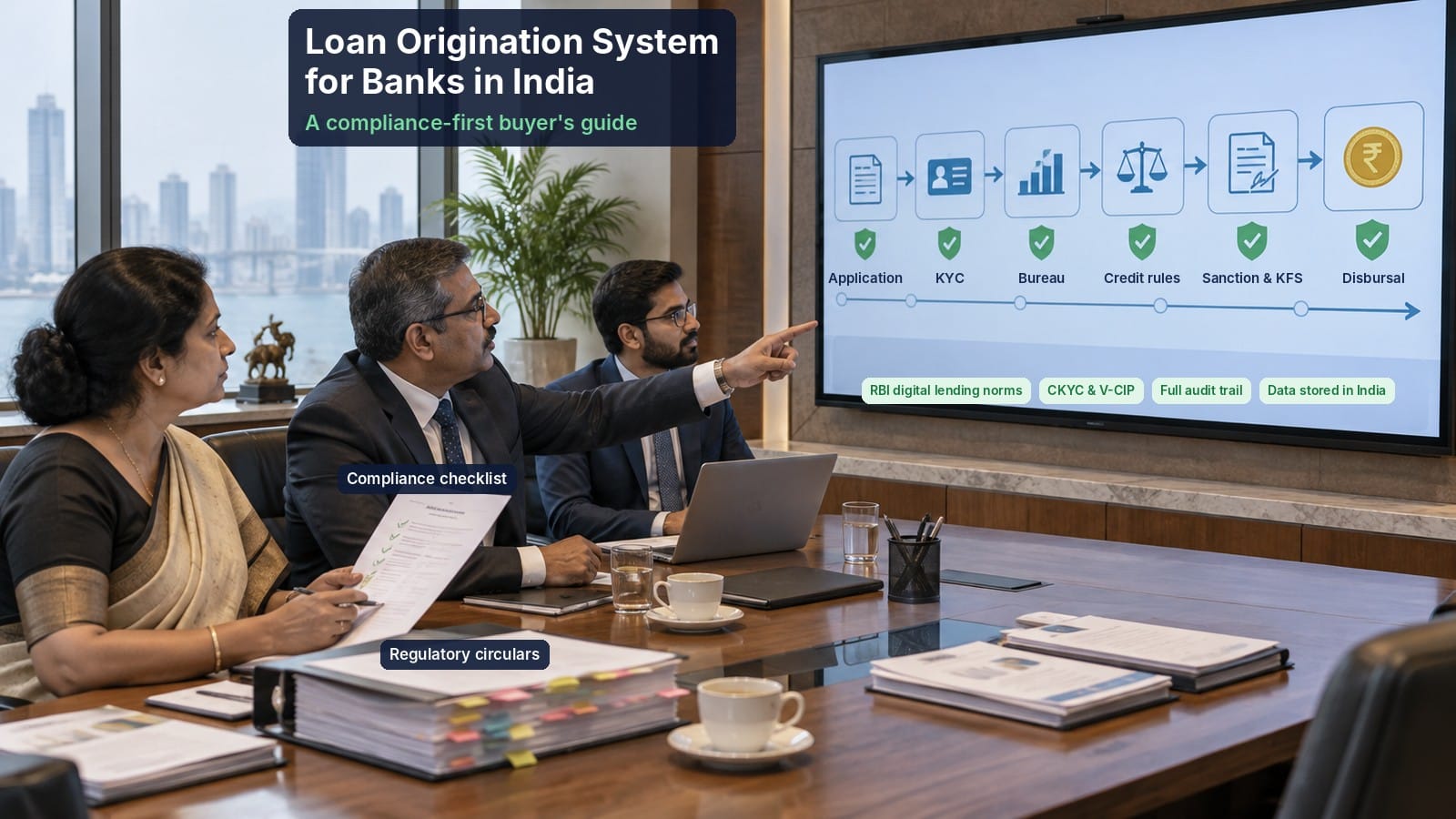
Short answer: A loan origination system for banks in India must do two jobs: decide fast and prove compliance. In 2026 that means configurable rules (BRE), KFS and APR generated per loan, cooling-off handling, CIC reporting and DPDP-grade consent, all tied to the LMS and collections. Evaluate vendors on these seven controls before features.
India’s digital credit engine is now running at scale. Digital NBFCs alone sanctioned 3.4 crore personal loans worth ₹64,656 crore in April to June 2026, about 70% of personal loan volume (FACE, 2026). Yet the average bank personal loan in that quarter was ₹4.52 lakh against ₹18,802 for digital NBFCs. Banks lead on loan value, while digital NBFCs lead on volume.
What usually holds banks back is the loan origination system itself: rigid workflows, rules hard-coded by the vendor, and compliance bolted on after each RBI circular. This guide shows how to evaluate a loan origination system for banks in India when regulation sets the bar.
What is a loan origination system, and how is it different from an LMS?
An LOS takes a loan from application to disbursement, and an LMS services it from disbursement to closure. A BRE makes the decisions, and an LCS handles recovery.
The four systems map to four stages of one lifecycle:
| System | Stage it owns | Core jobs | Typical owner |
|---|---|---|---|
| LOS (Loan Origination System) | Lead to sanction to disbursement | Application capture, KYC, document collection, bureau pull, underwriting workflow, KFS, e-sign, disbursement | Retail / MSME lending head |
| BRE (Business Rules Engine) | Every decision point | Eligibility, pricing, deviation routing, policy rules, scorecards | Credit / risk head |
| LMS (Loan Management System) | Disbursement to closure | Schedules, accruals, repayments, prepayment, restructuring, NPA classification | Operations / finance |
| LCS (Loan Collection System) | Overdue to recovery | Bucket strategy, allocation, field and digital collections, recovery agent controls | Collections head |
In practice, most compliance failures happen where these systems connect. A cooling-off exit starts in the LOS but must reverse entries in the LMS. A KFS figure computed by the BRE must match what the LMS later charges. So check how the modules connect, as well as what each one does.
What do RBI’s digital lending rules require from a loan origination system for banks in India?
RBI’s digital lending rules turn several LOS features into regulatory obligations: KFS before signing, APR disclosure, a cooling-off exit, direct disbursement, CIC reporting and DLA reporting.
RBI consolidated its digital lending framework into the Reserve Bank of India (Digital Lending) Directions, 2025, issued on 8 May 2025. These replaced the 2022 Digital Lending Guidelines and the 2023 Default Loss Guarantee guidelines. On 28 November 2025, RBI then issued 244 consolidated Master Directions replacing over 9,000 circulars, carrying these provisions into entity-wise directions for banks, co-operative banks and NBFCs.
Here is what each rule means for the software you buy:
| Regulatory requirement | What the LOS / stack must do |
|---|---|
| Key Fact Statement (KFS) before the loan agreement is executed | Generate a KFS per loan, from live pricing, in the borrower’s language; store the version the borrower saw |
| All-inclusive APR disclosure | Compute APR from rate plus all fees in the BRE; block disbursement if KFS and agreement figures differ |
| Cooling-off period of at least 1 day, set by the board and disclosed in the KFS | Track the window per loan; process an exit by principal plus proportionate interest; push reversal to the LMS |
| Disbursement only to the borrower’s account (no pass-through via LSP or pool accounts) | Hard-code disbursement routing; flag any third-party account in the workflow |
| Multi-lender LSP arrangements (effective 1 November 2025) | If you source through LSPs, ensure offers carry RE name, amount, tenor, APR and a KFS link |
| DLA reporting on RBI’s CIMS portal (from 15 June 2025) | Maintain an auditable register of every app and journey that originates your loans |
| Reporting digital loans to CICs | Automate bureau reporting from the LMS, including short-tenor products |
| Technology and cybersecurity standards | Audit trails, access controls and data localisation for borrower data |
Two other deadlines also matter. The DPDP Rules, 2025 were notified on 13 November 2025, with most obligations enforceable from 13 May 2027. Consent capture, purpose limitation and erasure therefore need to be built into the origination journey itself.
And model governance is tightening. RBI’s draft Guidance on Regulatory Principles for Model Risk Management (24 June 2026) proposes a board-approved framework for all models, including third-party and AI/ML scorecards. If your business rules engine runs scorecards, your LOS vendor’s models are in scope.
How much can a business rules engine cut loan TAT and cost?
A BRE removes manual review from the files that do not need it. Most of the saving comes from straight-through processing (STP).
The model below is illustrative. Replace the assumptions with your own file counts and costs.
| Metric (10,000 applications/month) | Manual underwriting | Rules-driven (BRE) underwriting |
|---|---|---|
| Files auto-decided (STP) | 0% | 60% |
| Files needing manual review | 10,000 | 4,000 |
| Analyst time per manual file | 45 minutes | 25 minutes (pre-filled, flagged) |
| Total analyst hours | 7,500 | About 1,670 |
| Cost at ₹600 per loaded analyst hour | About ₹45 lakh/month | About ₹10 lakh/month |
| Indicative annual saving | Not applicable | About ₹4.2 crore |
The arithmetic: 10,000 × 45 minutes = 7,500 hours. With a BRE, 4,000 × 25 minutes comes to about 1,667 hours. At ₹600 per hour, monthly cost falls from about ₹45 lakh to about ₹10 lakh.
Three conditions decide whether the saving is real:
- Rules owned by credit, not IT. If every policy change needs a vendor change request, STP decays within two quarters.
- Clean data at entry. Account Aggregator, bureau and KYC data must flow in pre-validated. Re-keying kills STP.
- Deviation discipline. Every manual override should carry a reason code, so rules can be tuned monthly.
How does a modern lending stack compare with a legacy LOS?
A legacy LOS digitises paper workflows. A modern stack makes policy, compliance and data configurable, so the lender changes rules without a release cycle.
| Dimension | Legacy LOS | Modern, API-first lending stack |
|---|---|---|
| Rule changes | Vendor change request; weeks | Credit team configures in BRE; same day, with maker-checker |
| Product launch | New build per product | New product from configured templates |
| Compliance updates (KFS, APR, cooling-off) | Patched after each circular | Parameterised; versioned per regulation |
| Data intake | Manual upload, re-keying | AA, bureau, KYC and income APIs at entry |
| Link between LOS and LMS | Batch file, nightly | Real-time events in both directions |
| Audit trail | Partial, per module | End-to-end per loan, regulator-ready |
| Deployment | On-premise only | On-premise, private cloud or hybrid, with data in India |
How should a bank or NBFC evaluate an LOS vendor?
Score vendors on seven controls, weighted toward compliance and change-speed, before you compare screens.
The 7-point LOS evaluation checklist
- Regulatory mapping. Can the vendor show each RBI digital lending requirement mapped to a feature, with evidence?
- Rule ownership. Can your credit team change eligibility, pricing and deviation rules without code, under maker-checker?
- KFS and APR integrity. Is the KFS generated from the same pricing engine that drives the agreement and the LMS?
- Lifecycle joins. Do cooling-off exits, restructuring and closures flow between LOS, LMS and collections in real time?
- Data and consent. Does the journey capture DPDP-grade consent, and is all borrower data stored in India?
- Model governance. For any scorecard or AI model, does the vendor provide documentation, validation support and audit rights?
- Time-to-live. What is the realistic go-live for your first product, and for each additional product after that?
A simple scoring rule: weight items 1, 3 and 4 at 20% each, and the other four at 10% each. Any vendor scoring below 3 out of 5 on item 1 should be dropped, regardless of price.
Should you buy an integrated LOS, LMS and LCS stack or best-of-breed modules?
Choose integrated if compliance consistency and speed matter most; choose best-of-breed only if you have a strong in-house integration team.
Best-of-breed can win on individual features. But every boundary between vendors is a place where KFS figures, cooling-off reversals and CIC reports can drift. For most banks, SFBs and mid-sized NBFCs, one data model across origination, loan management and collections lowers audit effort more than any single feature raises output.
Definitions
- Loan Origination System (LOS): software that manages a loan from application to disbursement.
- Business Rules Engine (BRE): a configurable layer that applies credit policy, pricing and eligibility rules automatically.
- Key Fact Statement (KFS): RBI-mandated summary of a loan’s cost and terms, given before the agreement is signed.
- Annual Percentage Rate (APR): the all-inclusive annual cost of credit, including fees.
- Straight-through processing (STP): applications decided end-to-end with no manual intervention.
How Trustt approaches this
Trustt is a B2B BFSI technology platform that provides digital lending, distribution, identity and AI infrastructure to banks, NBFCs and insurers in India. Trustt is a technology service provider; it does not lend.
The Trustt Digital Lending Platform covers the full lifecycle in one stack: LOS for origination, BRE for decisions, LMS for servicing and LCS for collections. That design targets the joins described above. Pricing set in the BRE flows into the KFS, the agreement and the LMS from the same source. Cooling-off exits and closures move between modules in real time instead of in nightly batch files. The Trustt Digital Identity Suite handles KYC and verification inside the origination journey.
Frequently asked questions
What is a loan origination system for banks?
A loan origination system (LOS) is software that manages a loan from application to disbursement. It captures applications, runs KYC and bureau checks, routes underwriting, generates the Key Fact Statement and agreement, and triggers disbursement. In India, a bank’s LOS must also support RBI digital lending requirements such as APR disclosure and cooling-off handling.
What is the difference between an LOS and an LMS?
An LOS handles everything before money moves: application, verification, underwriting and sanction. An LMS handles everything after: repayment schedules, interest accrual, prepayments, restructuring and NPA classification. The two must share data in real time, because events like a cooling-off exit or a prepayment start in one and must be reflected in the other.
Which RBI rules apply to digital lending software?
The RBI (Digital Lending) Directions, 2025, issued on 8 May 2025 and later folded into RBI’s November 2025 consolidated Master Directions, set the core requirements. These include a Key Fact Statement, APR disclosure, a cooling-off period of at least one day, direct disbursement, CIC reporting and reporting of digital lending apps on RBI’s CIMS portal.
What does a business rules engine do in lending?
A business rules engine applies a lender’s credit policy automatically. It checks eligibility, calculates pricing and APR, scores applications and routes exceptions to the right approver. A well-configured BRE lets the credit team change rules without code, and enables straight-through processing for low-risk applications, which shortens turnaround time and reduces manual underwriting cost.
How can banks reduce loan turnaround time (TAT)?
Banks cut loan TAT by removing manual steps that add no judgement. The main levers are pre-validated data at entry through Account Aggregator, bureau and KYC APIs; a business rules engine that auto-decides low-risk files; e-sign and e-stamp at sanction; and real-time links between origination and disbursement systems. Straight-through processing rates drive most of the gain.
What should an NBFC look for in an LOS?
An NBFC should look for configurable rules owned by its credit team, KFS and APR generated from one pricing engine, support for co-lending and LSP-sourced journeys, real-time LMS integration, DPDP-compliant consent capture and data stored in India. Time-to-launch for new products matters, because NBFC product cycles are shorter than most banks’.
Do the DPDP Rules affect loan origination?
Yes. The Digital Personal Data Protection Rules, 2025 were notified on 13 November 2025, with most obligations enforceable from 13 May 2027. Loan origination journeys collect significant personal data, so lenders need purpose-specific consent, notices, retention limits and erasure workflows built into the LOS itself.
Conclusion
In 2026, choosing a loan origination system is a regulatory decision as much as a technology one. Lenders that treat RBI’s digital lending rules as a design spec, and keep rules in the hands of credit teams, will launch faster and audit cheaper. Start with the seven-point checklist above. For the AI side of the stack, read our guide to AI agents for banks in India.
Talk to Trustt’s lending team for a stack assessment against the 7-point checklist
Sources
- Reserve Bank of India (Digital Lending) Directions, 2025, RBI, 8 May 2025
- RBI Monthly Bulletin: consolidated Master Directions, RBI, November 2025
- RBI Digital Lending Directions, 2025: an overview, Argus Partners, 2025
- Draft Guidance on Regulatory Principles for Model Risk Management, RBI, 24 June 2026
- MeitY notifies final DPDP Rules, 2025, S.S. Rana & Co., November 2025
- Digital NBFCs vs banks: personal loan data, Q1 FY27 (FACE), Business Today, 2 October 2026