Short answer: AI agents for banks in India deliver clear ROI today in service deflection, early-bucket collections, lead qualification, KYC assistance and internal copilots. They do not yet pay off in autonomous credit decisions. RBI’s FREE-AI framework and its 2026 draft model-risk guidance make board-approved governance, human oversight and vendor accountability basic requirements.
AI adoption in Indian finance is still shallow. When RBI’s FREE-AI committee surveyed regulated entities, only 20.8% were deploying or developing AI systems, and adoption among smaller co-operative banks was close to zero (FREE-AI Report, 2025).
Globally, adoption is not the same as payback. A 2026 Cambridge survey found 81% of financial services firms adopting AI, but only 40% reported higher profitability from it. For Indian CXOs, the useful questions now are which use cases pay back, and what RBI will expect them to prove.
What are AI agents for banks, and how are they different from chatbots?
An AI agent understands a request and then acts on the bank’s systems, such as fetching a statement, updating a lead or scheduling a payment. A chatbot can only answer questions.
The difference matters for ROI. A chatbot that answers FAQs saves a few calls. An agent that can verify a customer, read the loan account and set up a payment link closes the task. That needs access to the systems of record: LOS, LMS, core banking and identity rails.
It also matters for risk. The more an agent can do, the more it falls under model risk, outsourcing and consumer protection rules.
Where do AI agents deliver ROI for banks and NBFCs today?
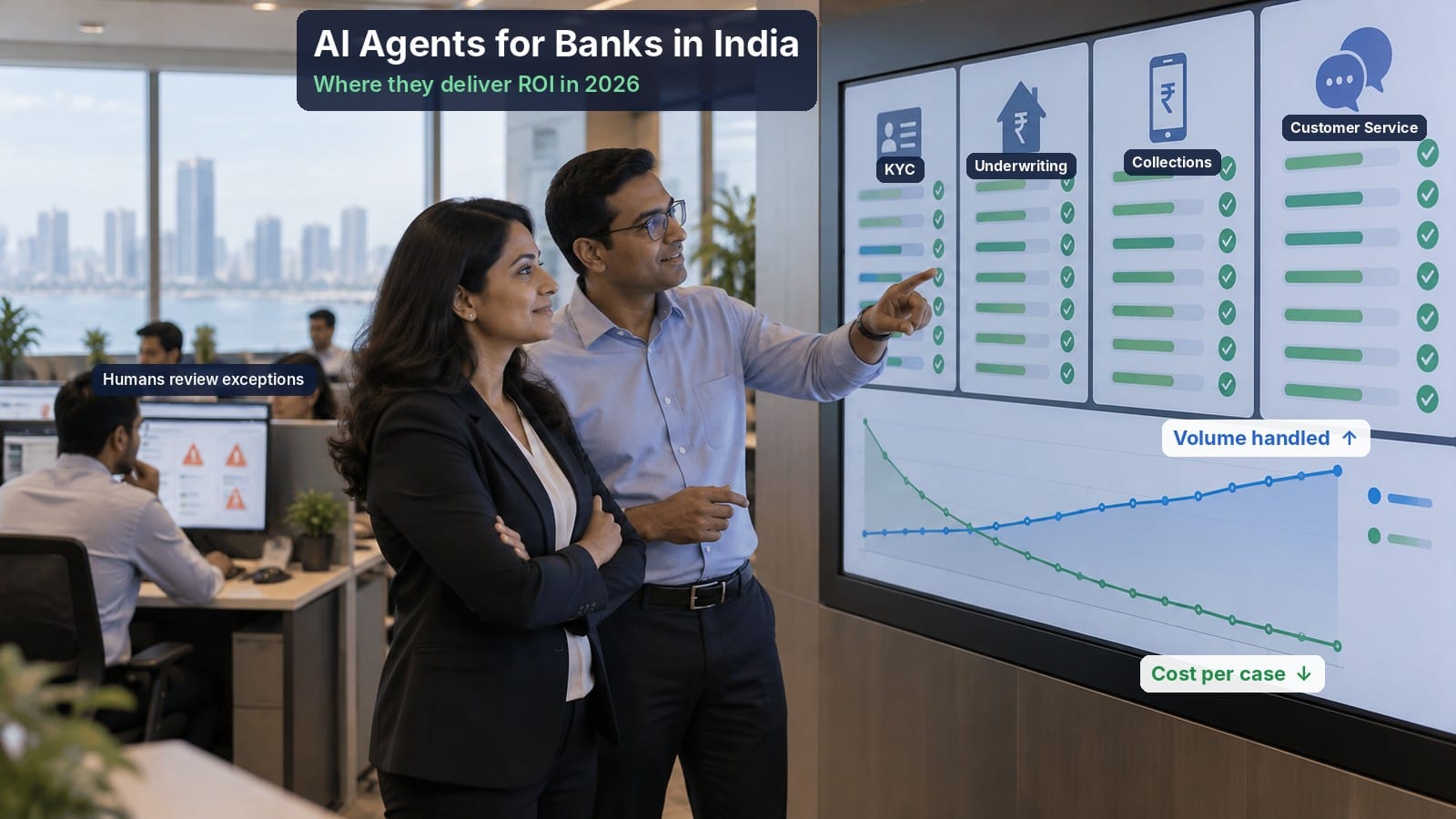
ROI is strongest where volumes are high, actions are reversible and a human can review exceptions: service, early collections, lead qualification, KYC assistance and internal copilots.
The Trustt AI Agent ROI Map scores six common use cases on impact, implementation risk and regulatory sensitivity (1 = low, 5 = high). Scores reflect Trustt’s assessment framework, not survey data.
| Use case | What the agent does | Impact | Risk | Regulatory sensitivity | Verdict for 2026 |
|---|---|---|---|---|---|
| Service deflection | Answers balance, EMI, statement and status queries; raises service requests | 4 | 2 | 2 | Deploy now |
| Early-bucket collections (pre-due to 30 DPD) | Sends reminders, explains dues, shares payment links, captures promise-to-pay | 5 | 3 | 4 | Deploy with scripts and conduct controls |
| Lead qualification | Qualifies inbound leads, collects documents, books callbacks | 4 | 2 | 3 | Deploy now |
| Onboarding / KYC assistance | Guides document upload, flags mismatches, hands off to verified KYC flows | 3 | 3 | 4 | Deploy as assistant, not decision-maker |
| Internal ops copilots | Drafts credit memos, answers policy questions, summarises files for analysts | 3 | 2 | 2 | Deploy now (staff-facing) |
| Autonomous credit decisioning | Approves or rejects loans without human review | 5 | 5 | 5 | Not yet. Keep in BRE with human oversight |
AI in loan collections scores highest on impact and also on sensitivity. Agents must follow fair practices on recovery: contact hours, respectful language and accurate disclosures. Approved script libraries and full conversation audit trails are not optional.
Where do AI banking agents not deliver ROI yet?
AI agents underperform where decisions are irreversible, data is poor or the agent cannot act on core systems.
Four patterns recur in failed pilots:
- Standalone bots. A WhatsApp bot that cannot read the loan account answers questions and then hands off to a call centre. The bank ends up paying for both.
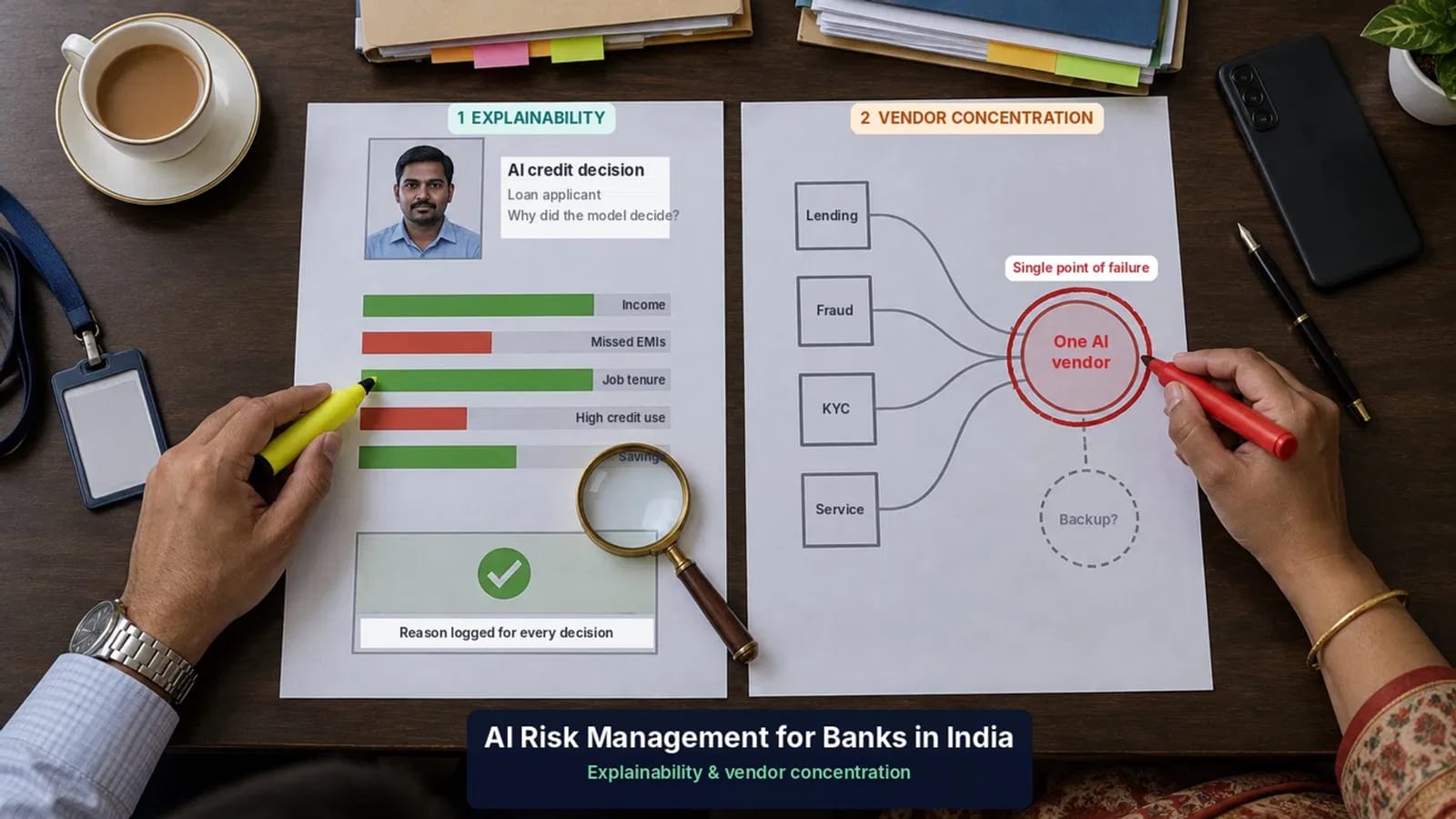
- Autonomous credit decisions. A wrong approval is hard to reverse, and explainability expectations are high (see why AI credit decisions in India stall at sign-off). Rules engines with scorecards and human review remain the safer design.
- Low-volume journeys. A specialised product with a few hundred queries a month rarely recovers integration cost.
- Unclear ownership. If nobody owns the agent’s error rate, quality drifts and complaints rise.
What does RBI expect from banks using AI?
RBI expects board-approved AI governance, explainability, human oversight and full accountability for third-party models. These come through the FREE-AI framework and the 2026 draft model-risk guidance.
Three instruments set the direction:
| Instrument | Status | What it means for AI agents |
|---|---|---|
| FREE-AI Framework (RBI committee report, 13 August 2025) | Released; recommendations, not binding directions | 7 Sutras and 26 recommendations under 6 pillars (Infrastructure, Policy, Capacity, Governance, Protection, Assurance). Recommends board-approved AI policies, AI inventories, incident reporting and disclosures |
| Draft Guidance on Regulatory Principles for Model Risk Management (24 June 2026) | Draft; public comments closed 24 July 2026 | Board-approved framework covering all models, including AI/ML and third-party models; risk-based tiering; human oversight; vendor documentation and audit rights |
| DPDP Act 2023 and DPDP Rules, 2025 (notified 13 November 2025) | Most obligations enforceable from 13 May 2027 | Purpose-specific consent for personal data used by agents; breach reporting; data principal rights |
The practical reading for CXOs: accountability does not transfer to the vendor. If a third-party agent mis-states dues or mishandles consent, the regulated entity answers for it. Contracts need documentation access, audit rights for both the bank and RBI, incident notification timelines and exit terms.
How should a bank decide which AI agent use case to deploy first?
Apply a three-gate test: the agent must act on real systems, its errors must be cheap to reverse and its decisions must be reviewable by a human.
The 3-Gate Test for AI agent use cases
- Rails gate. Can the agent act on systems of record (LMS, core, identity) through governed APIs? If not, it is a chatbot; expect limited ROI.
- Reversibility gate. If the agent errs, can the error be corrected within a day at low cost? Reminders pass; loan approvals do not.
- Review gate. Can a human see what the agent did and why, and step in? Logged conversations, reason codes and escalation paths are the minimum.
Use cases passing all three gates go to production first. Those failing the reversibility gate stay as assistants to human staff.
How do you measure ROI on an AI banking agent?
Measure the cost per resolved task and the improvement in business outcomes. Conversation counts on their own can mislead.
An illustrative service-deflection model (replace with your own volumes and costs):
| Metric | Value |
|---|---|
| Service queries per month | 2,00,000 |
| Share fully resolved by agent | 35% |
| Queries removed from human queue | 70,000 |
| Cost per human-handled contact | ₹40 |
| Monthly cost avoided | ₹28 lakh |
| Annualised | About ₹3.4 crore |
The arithmetic: 2,00,000 × 35% = 70,000 queries; 70,000 × ₹40 = ₹28 lakh per month. Net ROI must subtract platform, integration and monitoring cost.
For collections, track roll-forward rate from one bucket to the next, promise-to-pay kept rate and complaints per 1,000 contacts. For lead qualification, track qualified-lead-to-sanction conversion and cost per sanctioned loan.
Definitions
- AI agent: software that interprets a request and takes actions on connected systems within set permissions.
- Conversational AI: AI that interacts in natural language over chat or voice; an agent adds the ability to act.
- FREE-AI: RBI committee’s Framework for Responsible and Ethical Enablement of Artificial Intelligence, released 13 August 2025.
- Model risk management (MRM): governance of models across development, validation, deployment, monitoring and retirement.
- Human-in-the-loop: a design where a person reviews or approves an AI output before it takes effect.
How Trustt approaches this
Trustt is a B2B BFSI technology platform that provides digital lending, distribution, identity and AI infrastructure to banks, NBFCs and insurers in India. Trustt is a technology service provider; it does not lend.
TrusttAI builds AI banking agents that run on the same rails as the Trustt Digital Lending Platform and the Trustt Digital Identity Suite. Agents read loan accounts from the LMS, trigger verified KYC flows and log every action for review. That design addresses the three gates above: real rails, reversible actions and human review. It also supports the documentation and audit access that RBI’s draft model-risk guidance expects from third-party providers.
Frequently asked questions
What are AI agents in banking?
AI agents in banking are software systems that understand customer or staff requests in natural language and then take actions on the bank’s systems. Examples include fetching a loan statement, sharing a payment link or updating a lead record. Unlike basic chatbots, agents complete tasks end-to-end within defined permissions and with logged actions.
Are AI agents allowed under RBI rules?
Yes. RBI does not prohibit AI agents. Its FREE-AI framework (August 2025) encourages responsible adoption, and its June 2026 draft model-risk guidance sets governance expectations. Banks remain fully accountable for AI outcomes, including those from third-party vendors, and should have board-approved AI policies, human oversight and audit trails.
What is RBI’s FREE-AI framework?
FREE-AI is the Framework for Responsible and Ethical Enablement of Artificial Intelligence, a report released by an RBI committee on 13 August 2025. It sets out 7 guiding principles, called Sutras, and 26 recommendations under six pillars. It is guidance rather than binding regulation, but its ideas are being carried into RBI’s model-risk rules.
How is AI used in loan collections?
AI agents in collections send pre-due and early-overdue reminders, explain outstanding dues, share payment links and record promises to pay over WhatsApp, SMS or voice. They work best in early buckets with high volumes. Lenders must keep conduct controls in place, including approved scripts, contact-hour limits and full conversation logs.
Can NBFCs use a WhatsApp banking bot?
Yes, many NBFCs use WhatsApp for servicing and collections. The value depends on whether the bot can act on the loan account rather than only answer FAQs. NBFCs should ensure DPDP-compliant consent, verified customer identity before sharing account data, logged conversations and clear escalation to human agents.
What are the best generative AI use cases in BFSI?
The strongest generative AI use cases in BFSI today are service query resolution, early-stage collections, lead qualification, onboarding assistance and internal copilots for drafting credit memos or answering policy questions. These combine high volume with reversible actions. Fully autonomous credit decisions are not yet a sound use case.
How do banks measure ROI on AI agents?
Banks should measure cost per resolved task, share of queries fully resolved without human help and outcome metrics such as collections roll-forward rates or lead-to-sanction conversion. Conversation counts alone are misleading. Net ROI should subtract platform, integration, monitoring and governance costs.
Conclusion
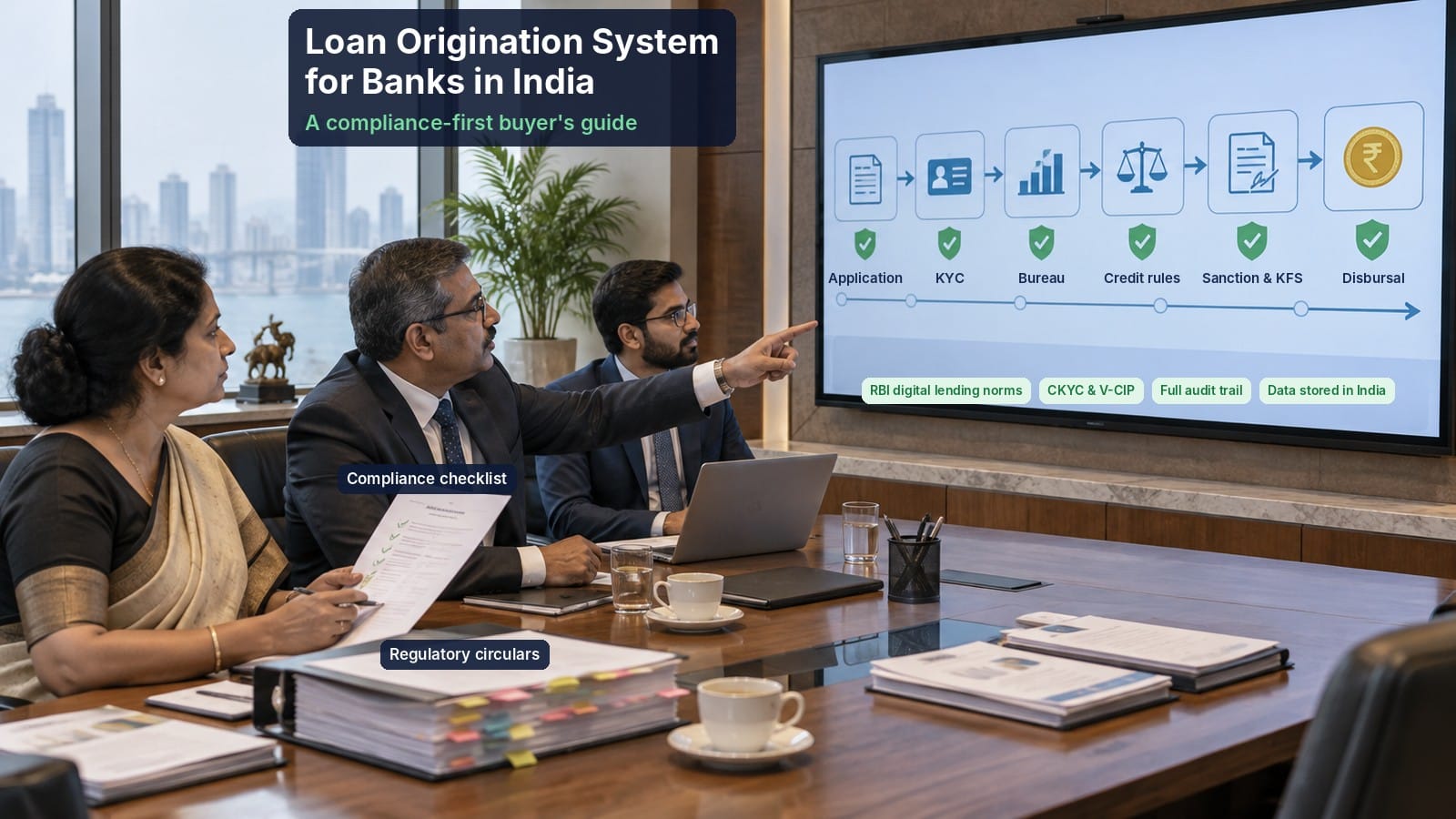
AI agents for banks in India are past the experiment stage, but ROI is uneven. Start with high-volume, reversible use cases that run on real systems, govern them as RBI’s draft model-risk guidance expects, and keep credit decisions with rules and people for now. If you are also reviewing your lending stack, see our loan origination system buyer’s guide.
See how TrusttAI agents run on your lending and identity rails
Sources
- RBI press release: Report of the FREE-AI Committee, RBI, 13 August 2025
- FREE-AI Framework summary and RBI survey findings, Khaitan & Co., 28 August 2025
- RBI FREE-AI committee report overview, KPMG India, August 2025
- Draft Guidance on Regulatory Principles for Model Risk Management, RBI, 24 June 2026
- 2026 Global AI in Financial Services Report, Cambridge Centre for Alternative Finance, 2026
- MeitY notifies final DPDP Rules, 2025, S.S. Rana & Co., November 2025