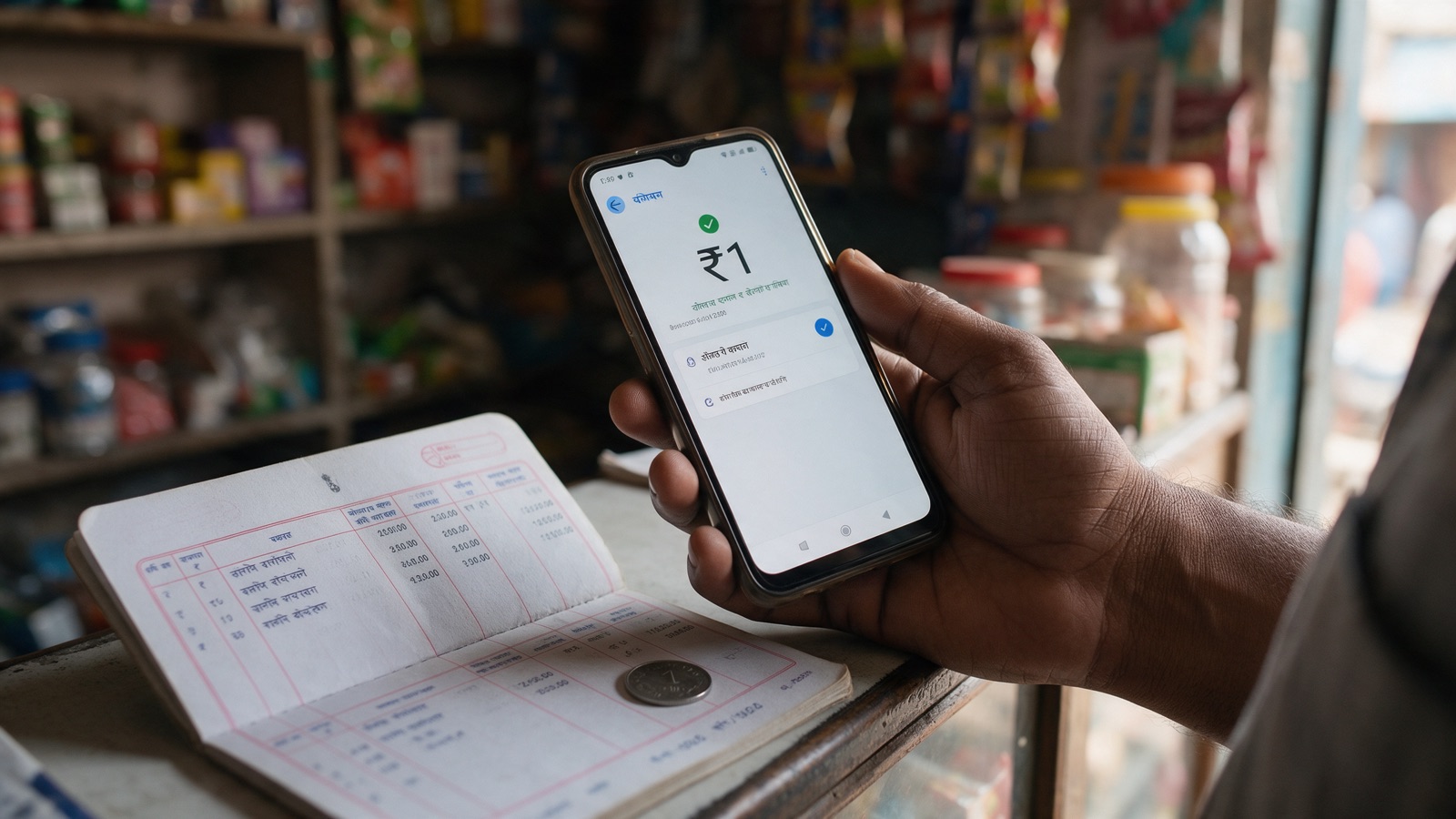
Penny drop verification sends ₹1 to a bank account over IMPS to confirm the account is live and to fetch the name it is held in. Indian lenders and fintechs run it before disbursal, payout or mandate registration, and it returns a result in seconds.
The name is misleading. The rupee is not the point. The point is the name that comes back with it, because that is the only part of a bank account a lender cannot verify any other way in real time.
A penny drop does not tell you the account is right. It tells you the account is real, and whose it is. Deciding whether that is close enough to your applicant is a policy question, not an API question.
What is penny drop verification?
The lender sends a nominal credit, almost always ₹1, to the account number and IFSC the applicant has supplied. The transaction runs over NPCI’s IMPS rail. If the credit succeeds, the beneficiary bank returns the name registered against that account in its core banking system.
Three things get established in one call:
- The account number and IFSC combination exists.
- The account is active and able to receive credits, so it is not dormant, frozen or closed.
- The name on the account, as the bank holds it.
The whole round trip typically takes a few seconds. The ₹1 stays in the applicant’s account.
Why lenders run it
A disbursal that lands in the wrong account is not a payment problem. It is a recovery problem, a customer complaint and, when it recurs, a fraud problem.
Four points in the lending journey depend on it:
- Before disbursal. The loan amount goes to the borrower’s own account, not a mule account or a mistyped one.
- Before mandate registration. An eNACH mandate registered against an account that does not exist fails on the first presentation, weeks later, with the loan already out.
- During onboarding. The account name is checked against the PAN and the applicant’s declared name.
- Before payouts to intermediaries. DSA and business correspondent commissions, vendor payments and refunds.
The cost of skipping it is asymmetric. Verification costs a rupee and a few seconds. A misdirected disbursal of ₹5 lakh costs a recovery effort that may never succeed.
Penny drop, pennyless, reverse penny drop: what is the difference?
| Method | What happens | Returns the account name? | Typical use |
|---|---|---|---|
| Penny drop | ₹1 credited to the account over IMPS | Yes, from the bank’s core banking system | Pre-disbursal and pre-mandate checks on a single account |
| Pennyless validation | Account and IFSC checked without moving money | Yes, where the bank supports the look-up | High-volume screening and cleaning existing customer records |
| Reverse penny drop | The applicant pays ₹1, usually by scanning a UPI request | Yes, and it also proves the applicant controls the account | Cases where ownership, not just existence, must be established |
| Beneficiary name look-up (RTGS/NEFT) | Remitter sees the beneficiary’s name before transferring | Yes, free of charge to the customer | Retail remittance inside internet and mobile banking |
That last row is the one that changed the landscape. In circular RBI/2024-25/99 dated 30 December 2024, the Reserve Bank of India directed banks participating in RTGS and NEFT to offer a beneficiary bank account name look-up facility, fetching the beneficiary’s account name from the bank’s core banking system using the account number and IFSC, and to do so no later than 1 April 2025, without any charge to the customer.
That facility is built for a remitter inside their own bank’s channel. It does not replace an API a lender calls inside its own origination flow, and the RBI’s circular notes that where the name cannot be displayed, the remitter may still proceed at their own discretion. But it has reset what customers expect: by 2026, an applicant who has seen a name appear in their UPI app will not accept “we sent it to the account number you gave us” as an explanation.
The hard part is the name match
A penny drop returns a string. The bank’s record may read “R KUMAR”, “RAJESH KUMAR” or “KUMAR RAJESH S”. The application says “Rajesh Kumar Singh”. The PAN says something else again.
An exact-match rule rejects a large share of genuine applicants and sends them to a manual queue. A loose rule lets through a close-but-different name, which is exactly the shape of an account takeover. Most lenders settle on a scored match with three outcomes: accept, reject, and refer to a human with both strings shown side by side.
Three rules make that work in practice:
- Score, do not compare. Normalise case, initials, honorifics, surname order and common spelling variants before scoring.
- Decide the thresholds in credit policy, not in code. The accept and refer bands should be visible to the credit and compliance teams and changeable without a release.
- Record the raw bank string. The decision has to be replayable later with exactly what the bank returned, not a cleaned version of it.
What penny drop does not tell you
It is worth being precise about the limits, because a verified account is often treated as a verified person.
- It does not prove the applicant owns the account. A successful credit and a matching name together make a strong case, but only a reverse penny drop, where the applicant pays from the account, proves control.
- It does not prove the account is the applicant’s primary account, or the one their salary lands in. That is a question for bank statement analysis or Account Aggregator data.
- It does not work outside India. The rails are domestic.
- It can fail for benign reasons. An account that does not accept IMPS credits, a bank outage or an NPCI timeout all return a failure that is not the applicant’s fault. Treating every failure as a rejection quietly loses good customers.
Failure handling is the whole design. A verification API that has no defined behaviour on timeout is a drop-off in waiting.
How Trustt does penny drop
Penny drop and eNACH sit in the Payments family of Trustt’s Digital Identity suite, alongside 100+ KYC and verification APIs covering Aadhaar, PAN, DigiLocker, business verification, Video KYC and document intelligence. Those APIs have run 500M+ checks, with a 99.95% uptime SLA and sub-second median response. Integration is sandbox first, one SDK, then production keys.
Inside the lending platform, the verification is not a standalone call. Account verification, eNACH mandate registration and the IMPS payout run as one disbursal movement, with an idempotency key required so a retry cannot create a duplicate disbursal. Every field carries its source, timestamp and confidence, so the name the bank returned is traceable in the decision record. Name-match thresholds are written as rules by the credit team in plain language and shipped the same day, with author and approver on record and one-action rollback, and upstream timeouts return a typed 424 error with a configurable fallback rather than a silent failure.
If a disbursal in your flow can still reach an unverified account, talk to a Trustt specialist.
Frequently asked questions
What is penny drop verification?
Penny drop verification is a method of validating an Indian bank account by crediting a nominal amount, usually ₹1, over NPCI’s IMPS rail. A successful credit confirms the account number and IFSC are valid and active, and returns the name the account is held in.
How does penny drop work?
The platform submits the account number and IFSC to a verification API, which initiates a ₹1 IMPS credit. The beneficiary bank either rejects it or accepts it and returns the registered account holder name. The result comes back in seconds and the ₹1 stays with the account holder.
Is penny drop verification mandatory in India?
There is no single rule requiring it for all lenders. It is standard market practice before disbursals and payouts. Separately, RBI circular RBI/2024-25/99 of 30 December 2024 required banks to offer a beneficiary account name look-up facility for RTGS and NEFT from 1 April 2025, free of charge.
What is the difference between penny drop and pennyless verification?
Penny drop moves ₹1 into the account to confirm it is live and fetch the name. Pennyless validation checks the account and IFSC and returns the name without any transaction. Pennyless is cheaper and better for bulk screening; penny drop additionally proves the account can actually receive credits.
What is reverse penny drop?
In a reverse penny drop, the applicant pays ₹1 to the platform, usually by approving a UPI request. Because the payment is initiated from the applicant’s own account, it proves control of that account, not just its existence. It is used where ownership must be established.
Why does penny drop verification fail?
Common reasons are a wrong account number or IFSC, a closed, dormant or frozen account, an account that does not accept IMPS credits, a bank-side processing error or an NPCI timeout. Several of these are not the applicant’s fault, so a retry or a fallback path should be defined.
Does penny drop confirm that the account belongs to the applicant?
Not on its own. It confirms the account is real and returns the name on it. Matching that name to the applicant is a separate policy decision. Only a reverse penny drop, where the applicant pays from the account, demonstrates control of it.
How long does penny drop verification take?
Seconds in the normal case, since it runs on the real-time IMPS rail. Delays usually come from the beneficiary bank or from NPCI, which is why an origination flow should hold the applicant with a clear status rather than blocking the journey on the response.
Technology you can bank on!
Researched and drafted with AI assistance under editorial review by Gautam Bandyopadhyay.
Sources
- Introduction of beneficiary bank account name look-up facility for RTGS and NEFT Systems, RBI/2024-25/99, CO.DPSS.RPPD.No.S987/04.03.001/2024-25, RBI, 30 December 2024
- IMPS product overview, NPCI